 LeafBound
Guide · Special editions
Special edition books for self-publishers: finishes, printers, files.
A special edition adds one or more physical finishes to the trade copy: sprayed or printed edges, foil or spot UV, a dust jacket, printed endpapers, a ribbon, interior art, a numbered limitation page or a signature. This guide says which printer does which finish, what each costs, which files you need and how to plan the run.
What a special edition is
A special edition is a copy of the book with at least one physical addition the standard copy lacks. The additions self-publishers use, roughly in order of how often they appear in recent campaigns, are:
- Sprayed or printed edges: color or artwork on the three cut edges of the book block.
- Foil: metallic or colored foil pressed onto the cover or jacket.
- Spot UV: a glossy clear coating on chosen areas of a matte cover.
- Dust jacket: a printed paper wrap with flaps around a hardcover.
- Printed endpapers: patterned or illustrated sheets inside the boards.
- Ribbon marker and head and tail bands: hardback trimmings.
- Interior art and page frames: chapter art, maps, character plates, decorative borders.
- Limitation page: a printed statement of the run size with a hand-written number.
- Signature: signed on the limitation page or on a tip-in sheet bound into the book.
The trade uses three overlapping labels. Special edition means extra material or one finish. Deluxe edition means several premium finishes together. Collector’s edition is the top tier, usually numbered and limited. Limited on its own only says the run is capped. None of these is a legal term, so the copyright page should state what the copy actually contains.
Why readers pay for them
The demand is measurable. Entangled’s deluxe first printing of Fourth Wing, 115,000 copies with black sprayed edges, sold out within a week of its April 2023 release (Wikipedia, Entangled Publishing, checked 4 November 2026). On the resale site Pangobooks, 63% of Fourth Wing sales were sprayed-edge copies, at up to about $120 against about $33 for a plain copy (Book Riot, 15 October 2025). A Written Word Media reader survey reported in July 2026 found that 30% of readers had bought a special edition and 23% would pay more for one (Indie Author Magazine, 10 July 2026).
For a self-publisher the point is not the trend but the margin. A finished hardback that costs £20 to print can sell as a £60 special edition when it carries the finishes readers recognise (ALLi, 4 November 2024). The rest of this guide is about delivering those finishes without a rejected file or a surprise invoice.
The finishes, one by one
Sprayed and printed edges
Sprayed edges are applied to the bound block after trimming, by a printer with the equipment: Bookvault from one copy at its UK facility, or 48 Hour Books in the US, which prints color straight onto the cut edges and calls it edge printing. Printed edges are a design placed in the 0.125 in bleed zone of every interior page, so the stacked bleed strips form the picture; any printer that prints bleed will print them, including KDP and IngramSpark, at color-interior prices. Bookvault calls the second method “forced edges” and will not refund problems with it. The sprayed edges and printed edges guide has the file setup for both.
Foil and spot UV
Both need a second file the same size as the cover: a black-on-white mask that tells the press where the foil or the clear coating goes. For foil the masked element is removed from the base art; for spot UV it stays. Bookvault takes both from one copy, 48 Hour Books offers eleven foil colors, Lulu foils spine text only, and IngramSpark and KDP offer laminate finishes only. The foil and spot UV files guide walks through the mask.
Dust jacket
A jacket is a single printed sheet: front flap, front, spine, back, back flap, plus bleed. Flap width is set by the printer (IngramSpark 3.25 in, 48 Hour Books 3.5 in, Mixam 2.5 in). KDP does not print jackets at all; its hardcover is case laminate. The dust jackets guide has the flap table and the width formula.
Printed endpapers
Endpapers are the sheets glued to the inside of the boards. Bookvault prints them on case-bound hardbacks for £1.50 a copy, supplied as pages inside your interior file; 48 Hour Books prints custom endsheets as a standard option; Mixam prices color endpapers as an extra. KDP, IngramSpark and Lulu list no printed-endpaper option. See the endpapers guide.
Ribbon, head and tail bands
Hardback only. Bookvault lists ribbons and head and tail bands at £1 each per copy (Bookvault special edition printing, checked 4 November 2026). Short-run and offset printers quote them with the binding.
Interior art and page frames
Character plates, maps and chapter art are ordinary interior pages: 300 dpi, bleed if the art reaches the edge, and color-interior pricing on POD for every color page. Decorative page frames and illuminated drop caps are part of the typesetting, and a frame that touches the trim turns the whole book into a bleed file. The page frames and borders guide covers the safe area, line weights and ebook implications.
Limitation page and signatures
No POD printer numbers copies. The printer prints a limitation page that states the run size and leaves a blank; the author numbers each copy by hand and signs either that page or tip-in sheets signed before the run. The limited numbered editions guide has the wording and the economics of a short-run hardback.
Who can print what
The matrix below is the question every planning thread ends up asking. “Not listed” means the printer’s product or help pages fetched on 4 November 2026 show no such option; “not stated” means the pages do not say either way. A “quote” cell means the printer offers the finish but publishes no price.
| Printer | Sprayed edges | Printed edges | Foil | Spot UV | Dust jacket | Printed endpapers | Ribbon | Minimum run |
|---|---|---|---|---|---|---|---|---|
| KDP | No | Yes, in the interior bleed | No | No | No (case laminate only) | No | No | 1 copy |
| IngramSpark | No | Yes, in the interior bleed | No (laminate only) | No | Yes, 3.25 in flaps | Not listed | Not listed | 1 copy |
| Lulu | Not listed | Not stated | Spine text only, linen jacket | Not listed | Yes, linen wrap with jacket | Not listed | Not listed | 1 copy |
| Bookvault | Yes, from £5 | Discouraged (“forced edges”, no refund) | Yes, from £2.50 | Yes (quote tool) | Not listed | Yes, £1.50, hardback | Yes, £1, hardback | 1 copy |
| 48 Hour Books | Yes, edge printing (quote) | Not stated | Yes, 11 colors (quote) | Diamond 3D clear (quote) | Yes, 3.5 in flaps | Yes, custom endsheets | Not stated | Not stated |
| Mixam | Not found | Not stated | On dust jackets; cloth by quote | Not stated | Yes, 2.5 in flaps | Yes, extra cost | Not stated | Not stated |
| Barnes & Noble Press | No | Yes, custom files | No metallic foil | Not stated | Yes | Not stated | Not stated | 1 copy |
Sources, all checked 4 November 2026: KDP Hardcover help (case laminate only, no dust jacket); IngramSpark on hardcover bindings (matte or gloss laminate; jacketed case laminate; cloth with jacket) and its File Creation Guide, 24 August 2026 (3.25 in flaps); Lulu foil article, 25 October 2023 and Lulu products; Bookvault special edition printing, Bookvault sprayed edges, Bookvault forced edges, Bookvault printed endpapers and Bookvault spot UV and foil colors, October 2025; 48 Hour Books cover options, updated 28 August 2026, its dust jacket page and its 1 September 2026 announcement; Mixam dust jackets, Mixam cloth covers and Mixam endpapers (Mixam pages were read from search snippets, as the site blocks automated fetches; confirm on the page); Barnes & Noble Press, 28 August 2025.
Typical costs
Per-copy add-ons as published on 4 November 2026. Print cost, shipping and the printer’s setup fees come on top.
| Finish | Published price | Printer or vendor |
|---|---|---|
| Sprayed edges, solid color | £5 per copy | Bookvault, from one copy, UK facility |
| Sprayed edges, custom design | £6 per copy | Bookvault |
| Edge printing | Quote | 48 Hour Books, hardcover and paperback |
| Printed-edge design file | $20 to $175 | PrintedEdges ($20 per style); Painted Wings ($35 to $175); then color-interior pricing at the printer |
| Foil | £2.50 paperback, £3 hardback per copy | Bookvault; 48 Hour Books by quote |
| Spot UV | Quote | Bookvault (listed as a foil option in its quote tool) |
| Dust jacket | $50 per order plus $3 per book up to 6 x 9 in | 48 Hour Books; IngramSpark, Lulu and Mixam price it in their calculators |
| Printed endpapers | £1.50 per copy | Bookvault, case-bound hardback, UK only |
| Ribbon; head and tail bands | £1 each per copy | Bookvault, hardback only |
| Hand-sprayed commission | $46 to $132 per copy (Etsy); $275 to $475 (studios) | Third-party edge artists; prices seen in listings, not quotes |
The file set you need
A trade paperback needs two PDFs. A full special edition can need eight files, each with its own template. Collect the printer’s templates before any artwork is commissioned, because flap widths, mask rules and endpaper page counts differ by printer.
| File | What it is | Who makes it |
|---|---|---|
| Interior PDF | The book block at trim size, with 0.125 in bleed on three edges if any page bleeds; PDF/X-1a:2001 or X-3:2002 | Formatter |
| Printed-edge art | Image strips placed in the bleed of every page, or a Bookvault sprayed-edge template with the design extended into the blue zones | Edge-file vendor or designer; Bookvault template |
| Cover PDF | Full wrap at the printer’s template size: back, spine, front, plus bleed | Cover designer |
| Foil mask | A second PDF the same size as the cover, foiled areas as 100% K on white, those areas removed from the base art | Cover designer |
| Spot UV mask | Same as the foil mask, but the highlighted areas stay in the base art | Cover designer |
| Dust jacket PDF | Flaps, back, spine, front and bleed as one spread, flap width per printer | Cover designer, printer template |
| Endpapers | Pages inside the interior file (Bookvault) or a separate spread file (press printers) | Designer |
| Limitation page | An interior page with the run size and a blank for the hand-written number | Formatter |
Two rules save the most re-uploads. First, if any interior page bleeds, every page must carry bleed, so printed edges, full-bleed art pages and bleeding frames all put the whole file on the bleed page size (see the bleed guide). Second, every file in the set must be the same trim and the same page count, because the spine width, the jacket width and the edge art all depend on the final page count. Lock the interior first.
A planning checklist
- Choose the finishes and the printer that does all of them in one run. Mixing printers means two sets of templates and two shipments.
- Fix the trim and binding. Sprayed edges at Bookvault need perfect-bound or case-bound, not spiral or wire-o. Jackets need a hardcover. Endpapers and ribbons are hardback only.
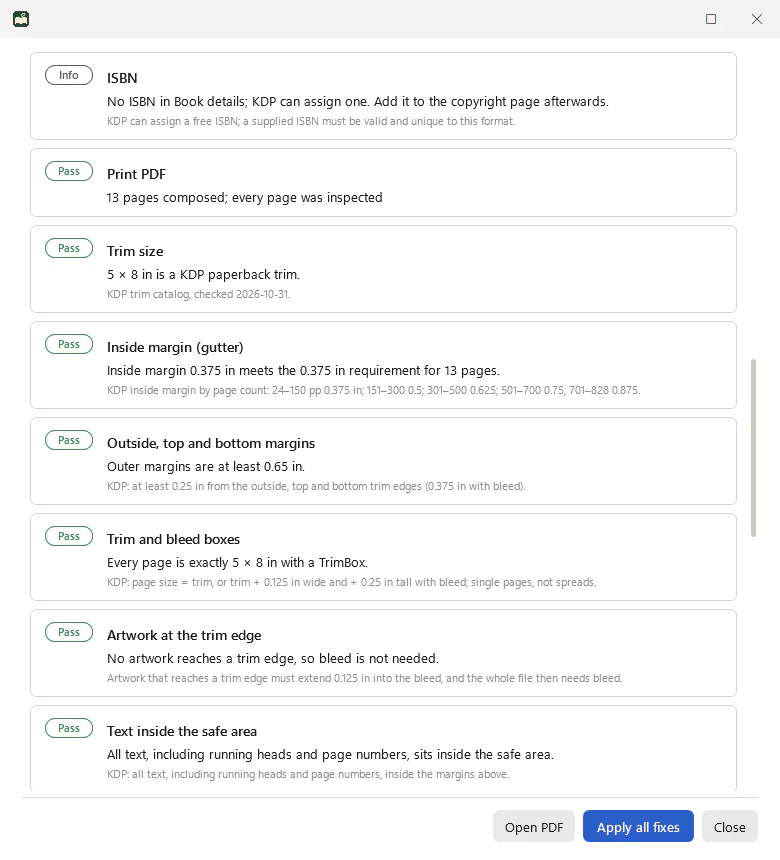
- Finish the interior and lock the page count. Run it through preflight so the trim box, bleed box and safe area are right before the edge art is cut to fit.
- Download every template from the printer: cover, jacket, edge, endpaper. Bookvault’s edge template appears in its quote tool once a title is added.
- Commission the art to those templates, at 300 dpi, with black as K100 where the printer asks for it.
- Order one proof with every finish on it. Cream paper, ink pull onto the first pages and foil registration all show up only in a physical copy.
- Decide the limitation before the run: how many numbered copies, how many unnumbered proofs and author copies, and where the signatures go.
- Assign ISBNs per format and record the edition on the copyright page.
- Schedule backwards from delivery: Bookvault moves any bespoke order to its UK facility; short-run printers quote lead times per job.
The economics, in two sentences
Recent self-published special-edition campaigns raised $13,000 to $25,000 from 185 to 230 backers at $57 to $133 average pledge, against per-copy finish costs of a few pounds each (Kicktraq figures, checked 4 November 2026). The Kickstarter guide lays out the reward ladder, the fees and the order real campaigns used for stretch goals.
Where LeafBound fits
LeafBound makes the interior of the book: the print PDF as PDF/X-1a:2001 or PDF/X-3:2002 with every font embedded, bleed “When needed” or on every page, 128 themes with chapter-opening ornaments and scene-break ornaments, 200 original artworks, your own heading images and ornaments in the Design area since 0.8.0, Compare themes side by side, and a print preflight that checks the finished PDF for trim and bleed boxes, artwork at the trim edge, text inside the safe area, image resolution, thin lines and embedded fonts. Every one of those checks matters more on a special edition, where a bleed error ruins the edge art as well as the page.
For the finishes themselves, the Studio tier adds LeafBound’s special-edition tools: art frames and custom borders; sprayed, gradient, stencil and printed edges; foil, spot-UV, emboss and deboss plates; dust jackets, case sheets and endpapers; and numbered limited runs. They write a finishing specification for a named printer, show the book in a 3D preview and run a special-edition preflight. LeafBound makes the files; the printer applies the finish, and not every printer offers every finish, so match the plan to the printer table above. Order a printed proof before the run. The print books page lists what the print side does.
Special edition questions
What makes a book a special edition?
Any physical addition to the standard trade copy: sprayed or printed page edges, foil or spot UV on the cover, a dust jacket, printed endpapers, a ribbon marker, interior art or page frames, a numbered limitation page, or a signature. One addition is enough to call the copy a special edition; most campaigns combine three or four.
What is the difference between a special, deluxe and collector’s edition?
A special edition adds extra material or one finish. A deluxe edition stacks several premium finishes (foil, edges, endpapers, ribbon). A collector’s edition is the premium tier, usually numbered or limited to a stated run. “Limited” on its own only means the run is capped. These are trade conventions, not legal terms, so say on the copyright page exactly what the copy includes.
How much does a special edition cost to make?
On top of the plain print cost: Bookvault lists foiling from £2.50, sprayed edges from £5, printed endpapers from £1.50, ribbons and head and tail bands £1 each, per copy, from a single copy (checked 4 November 2026). 48 Hour Books charges $50 per order plus $3 per book up to 6 x 9 in for a dust jacket. Printed-edge design files from third parties run $20 to $175. Prices change; the printer’s page is the final word.
Can you self-publish a special edition?
Yes, from one copy. Bookvault prints sprayed edges, foil, spot UV, printed endpapers and ribbons on single copies at its UK facility. 48 Hour Books prints edge designs, foil, custom endsheets and dust jackets in the US. For a numbered run, a short-run printer such as Imprint Digital takes hardbacks from 25 copies. The POD giants cover less: KDP prints none of these finishes, and IngramSpark offers a dust jacket but no foil or edges.
Which printer does sprayed edges?
Bookvault (solid color £5, custom design £6 per copy, UK facility, from one copy) and 48 Hour Books (edge printing on hardcover and paperback, quote). KDP, IngramSpark, Lulu and Barnes & Noble Press do not spray edges; on those, the route is printed edges, which are artwork in the 0.125 in bleed of every interior page. See the sprayed edges guide.
Does KDP do special editions?
Not as a service. KDP’s hardcover is case laminate only, with no dust jacket, foil, sprayed edges or printed endpapers (KDP Hardcover help, checked 4 November 2026). What you can do on KDP is design-side: printed edges in the interior bleed, interior art, a limitation page and a premium cover design. For foil, edges or a jacket, print that edition elsewhere and keep the KDP paperback as the trade copy.
Does a special edition need its own ISBN?
Each format and edition that is sold separately carries its own ISBN, so a special hardback sold alongside a trade paperback needs a new one. KDP requires a separate ISBN for its hardcover (KDP Hardcover help, checked 4 November 2026). Copies given only to campaign backers and never listed in trade still benefit from one, because printers and distributors key the title on it.
More guides
Get the interior right before the finishes.
Import your manuscript, pick a theme, lock the page count and let print preflight check bleed, safe area and resolution on the PDF your edge art and jacket will be built around.
Early access · Author from $79 once · free 4-day trial · Windows 10 and 11