 LeafBound
Guide · Special editions
Dust jackets for self-published hardcovers: flaps, formula, files.
A dust jacket is one printed sheet: front flap, front, spine, back, back flap, plus bleed, wrapped around a hardcover. KDP does not print them. IngramSpark, Lulu, 48 Hour Books, Mixam and Barnes & Noble Press do, each with its own flap width. This guide has the flap table, the width formula, the file setup and what to put on the flaps.
Who prints dust jackets
Start with the printer that does not. KDP’s hardcover is case laminate only: its help page says your hardcover book will not have a dust jacket, and that dust jackets, cloth bound and other hardcover formats are not available. KDP hardcovers come in five trims at 75 to 550 pages and need their own ISBN (KDP Hardcover help, checked 4 November 2026).
The printers that do, checked 4 November 2026:
- IngramSpark: jacketed case laminate (a printed case under the jacket) and cloth with jacket; 3.25 in flaps; maximum jacketed trim 6.14 x 9.25 in; matte or gloss laminate on the jacket (IngramSpark on hardcover bindings; File Creation Guide).
- Lulu: Hardcover Linen with Dust Jacket, in navy, black, gray, red, tan or green linen, with optional foil spine text; the jacket template comes from the pricing calculator (Lulu products).
- 48 Hour Books: 3.5 in flaps, 100# gloss text, silk or hi-gloss lamination, Diamond 3D foil and clear, two-sided printing on request, $50 setup per order plus $3 per book up to 6 x 9 in and $4 for larger or landscape (48 Hour Books dust jacket page).
- Mixam: jackets on hardcover, art, comic and cookbook products, color or grayscale, matte or gloss, with metallic foiling available; 2.5 in flaps on the inch table (Mixam dust jackets, read from search snippets as the site blocks automated fetches).
- Barnes & Noble Press: dust jackets on hardcover, with black-and-white or premium color interiors (B&N Press blog, 28 August 2025).
- Offset and short-run printers (PrintNinja, QinPrinting, Bookmobile and others) print jackets as a matter of course; their flap rules are in the table.
Flap width by printer
The flap is folded by the printer’s machine, so its width is the printer’s number, not yours. Plan on about 3 in, then replace it with the template figure.
| Printer | Flap width | Bleed | Other rules | Source |
|---|---|---|---|---|
| IngramSpark | 3.25 in (82.55 mm) | 0.125 in | Maximum jacketed trim 6.14 x 9.25 in; Cover Template Generator in My Tools | File Creation Guide, 24 August 2026 |
| 48 Hour Books | 3.5 in | At least 0.12 in | 100# gloss text; silk or hi-gloss lamination; $50 setup per order plus $3 per book up to 6 x 9 in | Dust jacket page |
| Mixam | 2.5 in (inch table) | 3 mm | Height = trim height + 6 mm (3 mm overhang + 3 mm bleed, top and bottom); single sheet | Support guides (snippets) |
| PrintNinja | At least 2.83 in, often one third of cover width | 0.125 in | Height = page height + 0.27 in; width per cover = page width + 0.3 in; spine + 0.04 in | Dust jacket file setup guide |
| QinPrinting | 2.3 in (5.5 x 8.5), 2.5 in (6 x 9 and 7 x 10), 3.5 in (8.5 x 11), 3.5 to 4.7 in landscape | 3 mm | Jacket paper 157 to 200 gsm, 250 gsm and up for embossing | Dust jackets page |
| Lulu | Per template from the pricing calculator | Per template | Hardcover Linen with Dust Jacket; foil spine text only | File setup guide (snippet) |
| Bookmobile | 3.5 to 4 in typical | Not stated | Same height as the case | Sizing page (snippet) |
| The Book Designer sample (6 x 9, 408 pages) | 3 in | Included in 9.25 x 20.095 in flat | 0.25 in turn; 1.22 in spine on 400 PPI paper | Template post, 15 December 2010 |
| KDP | No dust jacket | n/a | Case laminate only; 5 trims; 75 to 550 pages | KDP Hardcover help |
Links: IngramSpark File Creation Guide; 48 Hour Books; Mixam dust jacket guide; PrintNinja; QinPrinting; Lulu file setup guide; Bookmobile; The Book Designer; KDP.
The jacket width formula
Every term except the flaps and the bleed depends on the book. The cover width is the trim width plus the board overhang the printer uses; the spine depends on page count and paper; the overhang and the turn-in are the printer’s. That is why every printer in the table says “use our template generator”, and why the only safe sequence is: lock the page count, generate the template, then design.
A worked illustration for a 6 x 9 in book at IngramSpark’s 3.25 in flaps. The spine figure is a placeholder, not a calculation; read yours from the printer’s template.
| Term | Value | Running total |
|---|---|---|
| Two flaps | 2 x 3.25 in | 6.5 in |
| Back and front covers | 2 x 6 in | 12 in |
| Spine | Page count divided by the paper’s PPI, plus the two boards | 0.75 in (illustration only) |
| Bleed, left and right | 2 x 0.125 in | 0.25 in |
| Flat width before overhang | Sum | 19.5 in |
| Printer’s overhang allowance | Added per template (IngramSpark’s older matrix: + 0.4375 in on width, + 0.25 in on height for the case) | Per template |
Two published examples anchor the numbers. The Book Designer’s template for a 408-page 6 x 9 in book on 400 PPI paper is 9.25 x 20.095 in flat with 3 in flaps, a 0.25 in turn and a 1.22 in spine. PrintNinja’s rule is jacket height = page height + 0.27 in, each cover panel = page width + 0.3 in, spine + 0.04 in, flaps at least 2.83 in. Mixam’s metric guide is jacket height = trim height + 6 mm. The three agree on the shape of the formula and differ on the allowances, which is the point: the allowances belong to the printer.
File setup
- Lock the interior. The page count sets the spine, and the spine sets the jacket width. Change the page count after the jacket is designed and the title creeps off the spine.
- Generate the template from the printer (IngramSpark’s Cover Template Generator, Lulu’s pricing calculator, 48 Hour Books by quote). It arrives with the flap folds, spine edges, bleed and safe area drawn.
- Design on the template as one spread, at 300 dpi for raster art, with fonts embedded and the folds respected: no text within 0.25 in of a fold or the trim, and spine text centered on the spine with IngramSpark’s spine safety of 0.0625 in if the spine is wider than 0.35 in, half that if narrower.
- Bleed on all four outer edges: 0.125 in (3 mm) on the printers in the table; 48 Hour Books asks for at least 0.12 in.
- Export as PDF/X-1a where the printer prefers it (IngramSpark does), single page, no crop marks, and matching the template’s page size exactly.
- Order a proof. Flap folds land on the printer’s line, not yours; a jacket that is right in the PDF can still fold through a word.
If the jacket carries foil or spot UV, build the mask as a second PDF at the same size, following the foil and spot UV guide; 48 Hour Books and Mixam accept foil on jackets, the others do not.
What goes on the flaps
- Front flap: the blurb, usually 150 to 200 words at jacket type sizes, and the price in a top or bottom corner if the book is sold through shops. The flap is the first thing a browser reads after the cover.
- Back flap: the author photograph, a short biography, then the credits: cover illustration, jacket design, author photograph. A website or newsletter address goes here too.
- Back panel: endorsements, a longer description or a second image, plus the barcode with the ISBN and price if sold in trade. Keep the barcode in the printer’s barcode zone.
- Spine: title, author, publisher mark, reading top to bottom on English-language books.
- Inside the jacket: 48 Hour Books prints the reverse on request; campaigns use it for a map, a character chart or black-and-white sketches, as the Dungeon Crawler Carl hardcovers did with foiled jackets and sketches on the reverse (Beautiful Books, March 2025, checked 4 November 2026).
Case laminate, jacketed case laminate, cloth
| Binding | What it is | Who offers it |
|---|---|---|
| Case laminate | Cover art printed on the board wrap; no jacket | KDP, IngramSpark, Lulu (casewrap) |
| Jacketed case laminate | Printed board wrap plus a printed jacket over it | IngramSpark |
| Cloth with jacket | Plain cloth or linen case plus a printed jacket; foil spine text on Lulu | IngramSpark, Lulu; Mixam cloth by quote |
| Digital Cloth | A printed cloth texture on the case | IngramSpark, US and UK only |
Common mistakes
- Designing before the page count is final. The most common jacket re-print. A 16-page change moves the spine by a visible amount.
- Flaps at a guessed width. A 3 in flap on a 3.25 in fold leaves a strip of back-panel art on the flap.
- Text across a fold. The blurb runs from the flap onto the front panel because the safe area was ignored.
- No bleed on the flap ends. The jacket is trimmed at both flap ends and both long edges; all four need bleed.
- Uploading the jacket to KDP. There is no slot for it; KDP’s hardcover takes one case-wrap PDF.
- Forgetting the case under the jacket. Jacketed case laminate and KDP-style case wraps need their own cover file, often a plainer version of the jacket.
- Barcode outside its zone or at the wrong size; the printer rejects or re-places it.
Where LeafBound fits
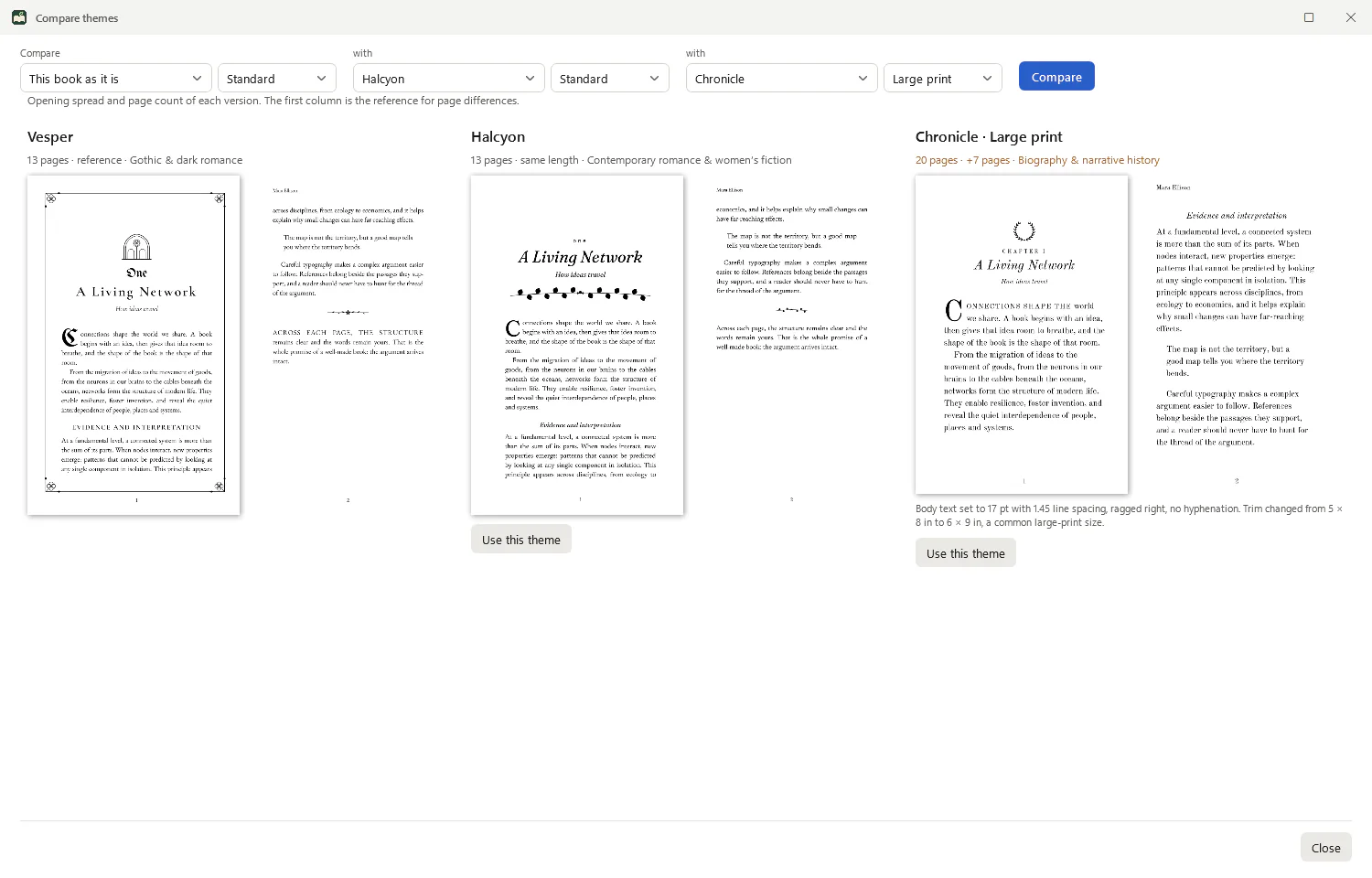
The jacket is built to the interior, so start there. LeafBound gives you the final page count from the real print PDF, with Compare themes showing the page count of up to three designs side by side before you commit, so the spine width is known before the cover goes to the designer. The print preflight checks the interior against the IngramSpark hardcover profile, including the inside margin for the final page count, and the export is PDF/X-1a:2001 or PDF/X-3:2002. Use the print calculator for the trim and spine figures and the IngramSpark formatting page for the interior rules.
LeafBound’s cover designer makes the print cover for a paperback, a full wrap with spine and barcode, for KDP and IngramSpark. In the Studio tier, the special-edition tools lay out dust jackets and case sheets (front, spine, back and flaps) and endpapers to the flap, spine and wrap conventions of named printers, with a finishing specification, a 3D preview and a special-edition preflight. LeafBound makes the files; the printer prints and wraps the jacket, and not every printer offers jackets (KDP does not). Check the file against the printer’s current template and order a printed proof.
Dust jacket questions
Does KDP print dust jackets?
No. KDP’s hardcover help says the book is printed as case laminate and will not have a dust jacket; dust jackets, cloth bindings and other hardcover formats are not available (checked 4 November 2026). For a jacketed hardcover, use IngramSpark, Lulu, 48 Hour Books, Mixam or Barnes & Noble Press.
How wide should dust jacket flaps be?
Whatever the printer’s template says, because the flap is folded by their machine. IngramSpark uses 3.25 in, 48 Hour Books 3.5 in, Mixam 2.5 in, PrintNinja at least 2.83 in, QinPrinting 2.3 to 3.5 in by trim, and Lulu generates the figure in its per-title template. Three inches is a sensible planning figure until the template is in hand.
What size is a dust jacket for a 6 x 9 in book?
It depends on the page count and the printer. The Book Designer’s 2010 sample for a 408-page 6 x 9 in book is 9.25 x 20.095 in flat, with 3 in flaps and a 1.22 in spine. The width formula is two flaps plus back, spine and front plus bleed, with the spine from the page count; use the printer’s template generator for the exact number.
What is the difference between case laminate and a jacketed case laminate?
Case laminate prints the cover art directly on the board wrap. Jacketed case laminate, an IngramSpark binding, prints the board wrap and adds a separate printed jacket over it, so the book has a cover under the jacket. Cloth with jacket puts a plain cloth case under the jacket, which is the trade hardcover look.
What goes on the flaps?
Front flap: the blurb, with the price in the top or bottom corner if the book is sold in shops. Back flap: author photograph and biography, then design and photography credits. Keep text at least 0.25 in from the folds and the trim, and remember the flap is read with the book closed.
Do I need a separate ISBN for the jacketed hardcover?
Each format sold separately carries its own ISBN, so a jacketed hardcover alongside a paperback or a case-laminate hardcover needs a new one. KDP requires a separate ISBN for its hardcover, and the same practice applies everywhere.
Can I put foil on a dust jacket?
48 Hour Books applies Diamond 3D foil, clear and textures to dust jackets, and Mixam offers metallic foiling on its jackets (checked 4 November 2026). IngramSpark, Lulu, KDP and Barnes & Noble Press do not. Build the foil mask as a separate file the same size as the jacket; see the foil and spot UV guide.
More guides
Know the page count before the jacket.
Import your manuscript, compare three themes with their page counts, and run print preflight so the spine width the jacket is built to is final.
Early access · Author from $79 once · free 4-day trial · Windows 10 and 11