 LeafBound
Guide · Special editions
Kickstarter for a special edition book: tiers, fees, stretch goals, timeline.
Recent self-published special-edition campaigns raised $13,000 to $25,000 from 185 to 230 backers at $57 to $133 average pledge, with foil, sprayed edges and dust jackets as the draw. This guide lays out the campaign structure, the reward ladder with its production cost per tier, the fees, the thirty-day run, the stretch goals in the order real campaigns used them, and the file and printing timeline that keeps the books deliverable.
Campaign structure
A book campaign has five parts, in order. A prelaunch page collects followers before the clock starts. A funding goal covers the print run, the finishes, shipping and fees at the base edition, with no stretch goal assumed. A reward ladder of five to seven tiers runs from a digital copy to a collector bundle. Stretch goals add finishes as the total passes set marks. And a timeline ties each of those to a print file, because every reward is a physical object someone has to make.
The scale of the market is the reason to bother. Kickstarter’s publishing category has passed $380 million pledged across more than 69,000 projects, with an average publishing pledge of $72 in the last year reported, and 20% to 30% of backers for early-career creators coming from Kickstarter’s own ecosystem rather than the author’s list (Indie Author Magazine, 10 July 2026, checked 4 November 2026). The same article reports a Written Word Media survey in which 30% of readers had bought a special edition and 23% would pay more for one. Those numbers shape the ladder: most backers pay the standard or deluxe price, and a minority pays much more for the collector copy.
The reward ladder
The bands below are the ones the crowdfunding guides agree on, with the sample ladder PrintNinja publishes and the per-copy finish costs Bookvault lists (PrintNinja, updated 28 April 2026; Publishing Xpress, 28 August 2026; Bookvault special edition printing; all checked 4 November 2026).
| Tier | Price band | What it contains | Production cost per copy, on top of print |
|---|---|---|---|
| Digital | $1 to $5 (sample $3) | Ebook; sometimes an early-access chapter | Nothing per copy |
| Standard | $15 to $30 (sample $25) | Trade paperback or plain hardback, signed or not | Print cost only |
| Deluxe | $35 to $60 (sample $40) | Hardback with foil and sprayed edges; bonus content | Foil from £2.50, sprayed edges from £5 per copy at Bookvault |
| Collector | $100 and up (sample $75 bundle) | Deluxe copy plus dust jacket, printed endpapers, ribbon, interior art, numbering and a signature | Add endpapers £1.50, ribbon £1, jacket per printer; hand numbering is your time |
| Ultra | $250 and up (sample $300) | Collector copy plus a slipcase, original art, a name in the acknowledgements or a character named after the backer | Slipcase and extras by quote |
Three rules make the ladder work. The deluxe tier is where most of the money is, so it carries the two finishes readers recognise from the shelf, foil and sprayed edges, and nothing that changes the interior. The collector tier adds what costs you time rather than the printer money: the signature, the number, the extras. And every tier above standard includes everything below it, so a backer never chooses between the edition and the ebook.
Real campaigns and their numbers
Public campaign totals as reported by Kicktraq and the articles cited; tier prices on the campaign pages could not be retrieved, and nothing here is quoted from them.
| Campaign | Raised | Backers | Average pledge | Dates | Finishes |
|---|---|---|---|---|---|
| Unintended Cultivator: The Ascendant Edition (Shadow Alley Press) | $24,670 of a $9,999 goal (246%) | 185 | $133 | 5 to 29 May 2026 | Faux-leather foil-stamped hardcover, sprayed edges, custom interior art |
| Christmas With The Elf King (Lenore Stutznegger) | $13,208 of a $1,000 goal (1,320%) | 230 | $57 | 27 July to 18 August 2026 | Foiled cover, sprayed edges |
| Alkarra Awakening Deluxe Hardcover (Katie Cross) | $13,483 | 187 | About $72 | Last updated 1 August 2025 | Sprayed edges, foil, leatherette |
| Bastion Deluxe Hardcover (Philip Tucker) | Not retrieved | Not retrieved | Not retrieved | Delivery October 2025 | $75 collector tier: dust jacket, foiled faux-leather cover, gilded edges, interior illustrations; sprayed edges as a stretch goal |
| Dungeon Crawler Carl books 2 and 3 (Matt Dinniman) | Not retrieved | Book 1: about 6,000 | Not retrieved | Fulfilment 2026 | Signed and numbered limited hardcovers, foiled dust jacket with sketches on the reverse, sprayed edges |
Two patterns in the table. The highest average pledge belongs to the campaign whose base edition already carried three finishes and whose stretch goals added more; the campaign with the lowest goal, $1,000 for the Elf King, funded thirteen times over and still averaged $57, a deluxe price. And the finishes are the same four everywhere: foil, sprayed edges, a jacket, interior art. The special edition books guide says which printer does each.
Fees and pricing
The crowdfunding guides report Kickstarter’s fee as 5% of funds raised plus payment processing of about 3% to 5%, charged only if the campaign funds (Publishing Xpress, 28 August 2026; PrintNinja, 28 April 2026; checked 4 November 2026). Kickstarter’s own fee page is the final word and could not be fetched for this guide, so confirm it before pricing. Plan on 8% to 10% of the total gone before the first book is printed.
Pricing then runs backwards from the copy: print cost at the printer’s calculator, plus the finish costs per copy, plus packaging, divided by 0.9 for the fees, then marked up by at least 100% for ALLi’s rule, with shipping charged on top. A £20 hardback with £8 of finishes is £28 of cost, about £31 after fees, and a 100% markup puts the reward at about £62 before shipping. That arithmetic sets the reward price, not the price of a comparable traditionally published edition printed at offset quantities. Charge shipping separately, by region, at the survey stage; a flat figure baked into the tier is wrong for everyone outside your own country.
Thirty days
Thirty days is the length the guides recommend and the campaigns in the table used: 25 days for Unintended Cultivator, 23 for the Elf King. Pledges arrive at the start, when followers from the prelaunch page convert, and at the end, when the deadline does the work. The middle is quiet whatever the length, so a longer run spreads the same money over more quiet days and pushes delivery back. Spend the weeks you would have added on the prelaunch page instead.
Stretch goals, in the order real campaigns used them
A stretch goal is a finish added to every copy, or to every copy above a tier, when the total passes a mark. The rule that keeps the books deliverable: a stretch goal may change the cover, the jacket, the edges, the endpapers or what goes in the box, but not the interior, because the interior sets the page count and the page count sets everything else. The sequences below are the ones the sourced campaigns and Kickstarter’s publishing lead used (Kicktraq, checked 4 November 2026; Indie Author Magazine, 10 July 2026).
| Campaign | First | Second | Third | Fourth |
|---|---|---|---|---|
| Unintended Cultivator (May 2026) | 1. Illustrated dust jacket (9 May) | 2. Reversible dust jacket (14 May) | 3. Spot-gloss endpaper upgrade (20 May) | 4. Slipcase (referenced 26 May) |
| Christmas With The Elf King (July to August 2026) | 1. Art print | 2. Stickers | 3. Green ribbon bookmarks | Foil and sprayed edges were in the base edition |
| Bastion Deluxe Hardcover (2025) | Base: dust jacket, foil, gilded edges, illustrations | Stretch: sprayed edges | ||
| Kickstarter publishing lead’s example (Indie Author Magazine, July 2026) | At $10,000: French flaps and sprayed edges | Plus $2,000: ribbon | Then color or vellum inserts |
The pattern: the jacket first, because it is one more file at the same printer; then the endpapers, the cheapest finish on the list; then edges or a ribbon; then the slipcase and the extras. Each step is a file the cover designer can make without touching the interior, with a per-copy cost you already know from the quotes. The dust jackets, endpapers and foil and spot UV guides have the file setup for each. Set the marks from the per-copy cost multiplied by the expected copy count: a ribbon at £1 on 250 copies is £250, so it comes early; a slipcase by quote on the collector tier only is a later mark on a smaller count.
File and printing timeline
| When | What | Why |
|---|---|---|
| Before prelaunch | Finish the manuscript, choose trim and binding, lock the interior and the page count, run preflight | Everything else is built to this page count |
| Before prelaunch | Collect every printer template: cover, jacket, edge, endpaper; get per-copy quotes for each finish | Reward prices depend on these |
| Prelaunch page live | Cover art, mock-ups of the finishes, the base reward ladder, stretch goals in order | Kickstarter counts followers before launch |
| Campaign, 30 days | Updates as stretch goals are reached; no interior changes | Changing the page count now breaks the jacket, spine and edge art |
| Campaign close | Fees deducted; funds paid out; backer survey for addresses and tier choices | Shipping is priced per region here |
| Final files | Add the finishes reached to the file set; re-run preflight on the final interior; order one proof with every finish | The proof is the last cheap mistake |
| Print run | Order the full run; number and sign after delivery, or send tip-in sheets before binding | Bookvault bespoke orders move to its UK facility |
| Fulfilment | Printer ships from a backer spreadsheet, or you pack from the ledger | Bookvault accepts a backer spreadsheet (ALLi) |
The one date that cannot move is the proof. A campaign that funds in May and promises October delivery has to have the final files, with every finish reached, at the printer with time for a proof, a correction and the run. Bookvault moves any order with a bespoke finish to its UK facility (Bookvault help, checked 4 November 2026), short-run printers quote lead times per job, and offset printers overseas add shipping by sea; ask for the lead time with the quote and put it on the campaign page as the delivery month.
Entangled’s deluxe printing of Iron Flame is the cautionary example: a trade publisher at scale issued refunds for copies with bleeding edges and missing pages (Wikipedia, Entangled Publishing, read from a search snippet, checked 4 November 2026). One proof with every finish on it, in your hands before the run is ordered, is how a campaign of two hundred copies avoids the same.
Fulfilment
Two routes. The printer ships: Bookvault accepts a backer spreadsheet and ships from its facility (ALLi, 4 November 2024, checked 4 November 2026), which removes the boxes from your hallway but also removes the hand numbering and the signature unless those were done on tip-in sheets before binding. Or you ship: the run arrives, you number, sign and pack from the ledger. Many campaigns do both, with the standard tier shipped by the printer and the collector tier by hand.
Print on demand covers part of it. KDP and IngramSpark print the trade paperback and the printed-edge version, Lulu and IngramSpark print a jacketed hardcover, and all of them ship single copies. None does foil, sprayed edges or printed endpapers, so a campaign with those finishes prints them elsewhere; the sprayed edges guide covers the printed-edge route that works on POD.
Pitfalls
- A stretch goal that changes the interior. Added illustrations, a bonus chapter, a map: each changes the page count, and the jacket, spine and edge art were made to the old one.
- Finishes the chosen printer does not do. Foil promised on a KDP hardcover, a jacket on a Bookvault paperback. Match the ladder to one printer’s menu before launch.
- Fees left out of the goal. The goal is the money you need after 8% to 10% is gone.
- Shipping priced flat. Overseas backers cost more than the margin on a standard copy.
- The limitation page added after the run. A numbered edition needs the page in the interior before printing; see the limited numbered editions guide.
- A delivery date set before the lead time is known. Ask the printer first.
- No proof. Edge bleed, foil registration and cream paper under sprayed edges show only in a physical copy.
- Promising a closed run and leaving the POD listing live. A limited edition anyone can still order is not limited.
Where LeafBound fits
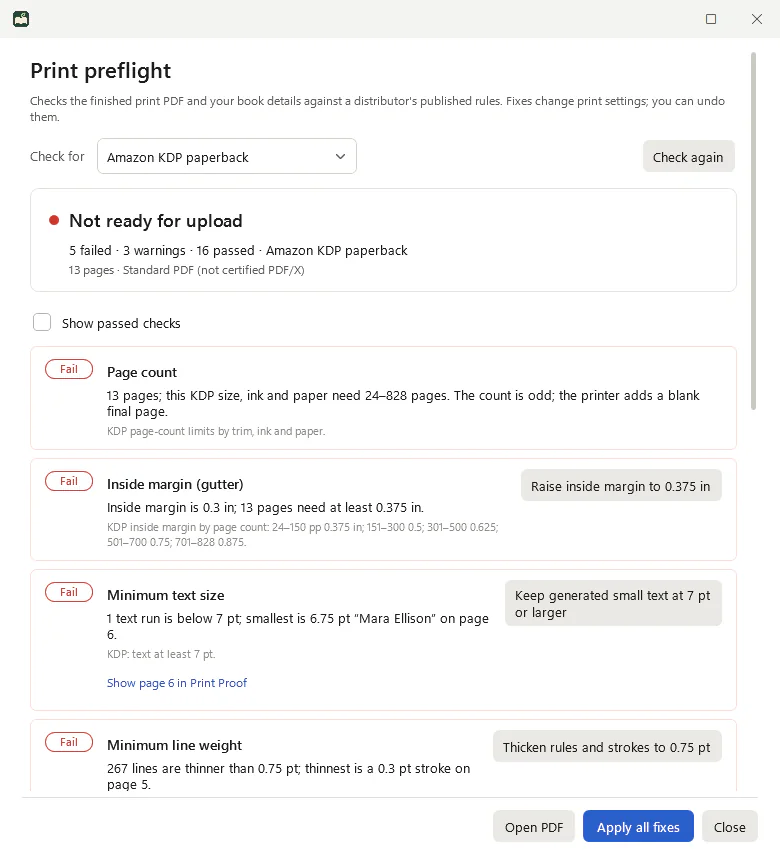
The interior is the file every reward is built to, so it comes first. Import the manuscript, pick a theme, use Compare themes to see the page count of up to three designs side by side, and lock the one you ship. Print and page setup handles trim and bleed, including bleed on every page for a printed-edge version. Print preflight reads the finished PDF and checks trim and bleed boxes, the safe area, image resolution, line weights and embedded fonts against the KDP or IngramSpark profile, with one-click fixes, so the page count the jacket and edge art depend on is final before prelaunch. The export is PDF/X-1a:2001 or PDF/X-3:2002, and the ebook editions for the digital tier come from the same book; the print books page lists what the print side does now.
For the finishes themselves, the Studio tier adds LeafBound’s special-edition tools: art frames and custom borders, sprayed and printed edges, foil, emboss, deboss and spot-UV plates, dust jackets, cases and endpapers, and numbered limited runs, with a finishing specification for a named printer, a 3D preview to show backers and a special-edition preflight. LeafBound makes the files; the printer applies the finishes, and not every printer offers every finish, so confirm the printer’s list before you promise a stretch goal. Order a printed proof before the run.
Kickstarter questions
What percentage does Kickstarter take?
The guides that track it report a 5% platform fee on funds raised plus payment processing of about 3% to 5%, charged only if the campaign funds (Publishing Xpress, 28 August 2026; PrintNinja, updated 28 April 2026; checked 4 November 2026). Plan on 8% to 10% off the top, and confirm the current figures on Kickstarter’s own fees page before you set prices.
How long should a book Kickstarter run?
Thirty days is the figure the crowdfunding guides and the recent campaigns converge on. Unintended Cultivator ran 5 to 29 May 2026 and Christmas With The Elf King ran 27 July to 18 August 2026 (Kicktraq, checked 4 November 2026). Most pledges arrive in the first and last few days; a longer run adds quiet days in the middle, not money.
How many reward tiers should a book campaign have?
Five to seven: a digital tier, a standard print tier, a deluxe tier, a collector tier and one or two bundles. More than that splits backers across choices that look alike; fewer leaves money on the table between the standard and the collector copy.
How much do Kickstarter special editions cost to make?
The finishes are a few pounds each per copy on top of print cost: Bookvault lists foil from £2.50, sprayed edges from £5, printed endpapers from £1.50 and ribbons at £1 (checked 4 November 2026). Print cost, shipping and the platform fees are the larger numbers. ALLi’s rule is to mark the edition up at least 100% over print cost and expect 45% to 55% profit before tax after shipping and fees.
What stretch goals do book campaigns use?
Finishes that can be added to the same print run without changing the interior: an illustrated or reversible dust jacket, upgraded endpapers, sprayed edges, a ribbon, a slipcase, then extras such as art prints, stickers and bookmarks. The guide lists the order real campaigns used. Avoid stretch goals that change the page count after the cover and edge art are made.
Can I fulfil a Kickstarter with print on demand?
Partly. KDP and IngramSpark print the trade copy and the printed-edge version, and Lulu and IngramSpark print a jacketed hardcover, but none of them does foil, sprayed edges or printed endpapers. Campaigns with those finishes print at Bookvault, 48 Hour Books or a short-run printer; Bookvault accepts a backer spreadsheet for fulfilment (ALLi, 4 November 2024).
Do readers actually want special editions?
A Written Word Media survey reported in July 2026 found that 30% of readers surveyed had bought a special edition and 23% would pay more for one (Indie Author Magazine, 10 July 2026, checked 4 November 2026). The campaign figures in the guide, with average pledges from $57 to $133, say the same thing in money.
Should the special edition be numbered?
If you promise a closed run, yes, and the limitation page then has to be in the interior file before the run is printed. Numbering is done by hand after delivery, because no printer numbers copies for you. The limited numbered editions guide has the page wording and the honesty rules.
More guides
Lock the interior before prelaunch.
Import your manuscript, compare themes with their page counts and run print preflight so the file every reward is built to is final before the campaign starts.
Early access · Author from $79 once · free 4-day trial · Windows 10 and 11