 LeafBound
Guide · Moving from Affinity
Move your book from Affinity to LeafBound.
Affinity by Canva (free; November 2026 release) has no RTF, DOCX or text export. LeafBound imports Word (.docx), RTF, Markdown, plain text and EPUB. So the route is the original Word file if you have one, otherwise a reflowable EPUB imported directly, or copy and paste into Word, then Heading 1, footnotes, import, theme, preflight. This guide gives the six steps, what transfers and what you rebuild, and when to stay.
Six steps from Affinity to a LeafBound book
An hour for a novel if the Word file still exists; an afternoon if the text has to be copied out and the footnotes rebuilt.
Find the manuscript, or get the text out
If the book started as a Word file, use that file and skip to step 3; it is the cleanest source. Otherwise, in Affinity, click in each text frame, select all to take the whole threaded story, copy, and paste into Word in chapter order. For a book of many stories, export File, Export, EPUB (Reflowable) instead: LeafBound imports the EPUB directly in step 4, or convert it to .docx in Calibre first if you want to tidy it in Word.
Assemble one manuscript in Word
One document for the whole book, chapters in order, front matter and back matter in their places. Delete any running-head or folio text that came along from a master page, and any manual table of contents.
Apply Heading 1 and re-insert footnotes
Select each chapter title and apply Heading 1; sections get Heading 2. Where footnotes arrived as plain text, put the cursor at the reference and use References, Insert Footnote, then move the note text in. The Word import guide has the full cleanup list.
Save as .docx and import into LeafBound
File, Save As, Word Document (.docx). Close Word, open LeafBound, create a book and import the file. Chapters appear from the Heading 1 titles, and smart import also finds parts, a prologue and back matter and lists anything it moved; footnotes, images and emphasis come across.
Choose a theme and re-place images
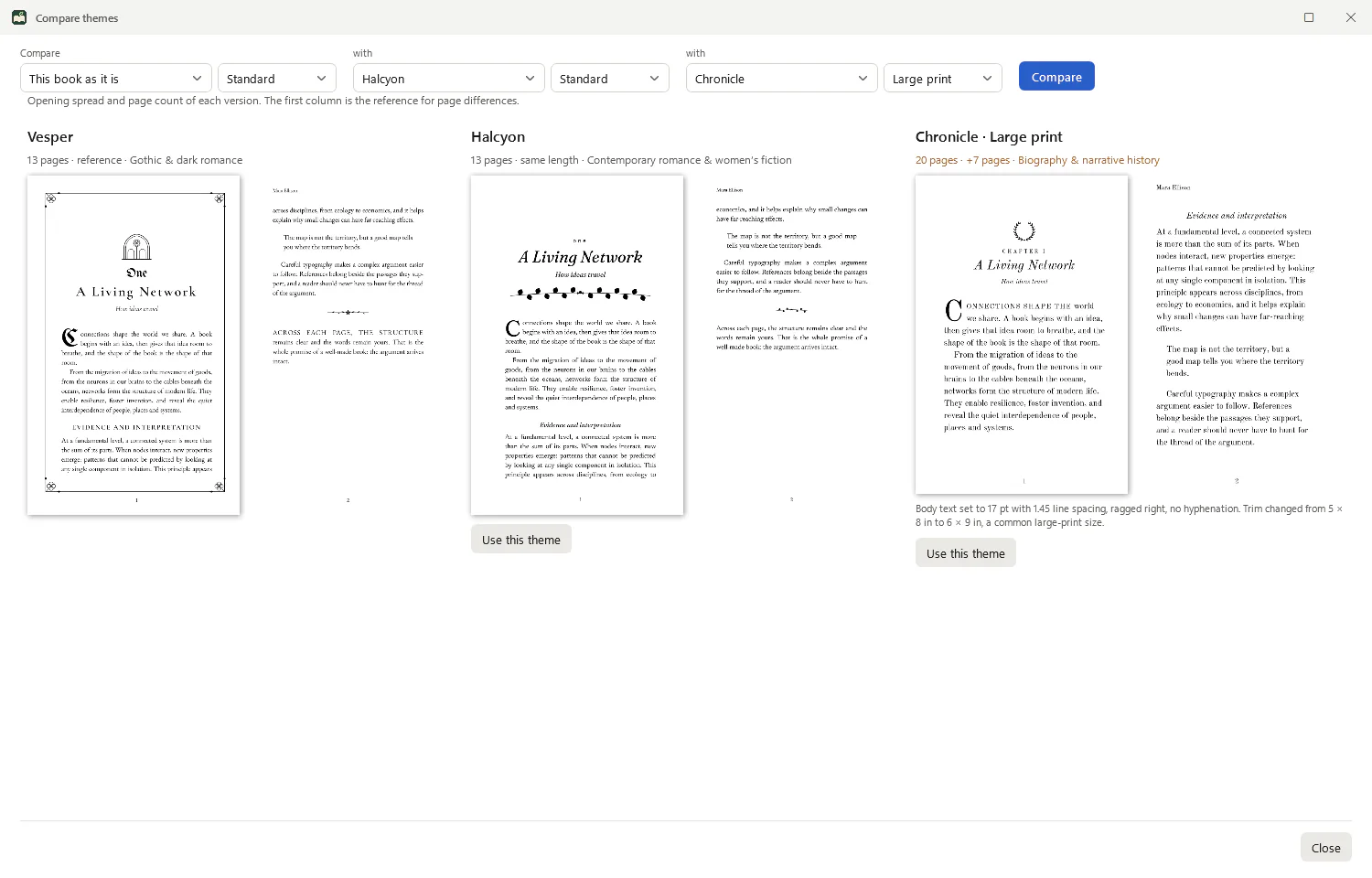
Pick one of the 128 themes, in Standard, Large print or Accessible, and set the trim, margins and bleed in Print and page setup. Insert images from the original files, inline, with a description each. Compare up to three themes side by side with page counts.
Run print preflight, then export
Choose the KDP or IngramSpark profile, run more than 25 checks on the generated PDF, apply the one-click fixes, and export PDF/X plus the ebook editions. Order a printed proof; the printer makes the final decision.
What you need, and why there is no export
A manuscript LeafBound can import: Word (.docx), RTF, Markdown, plain text or EPUB. Affinity can make only the EPUB. Its export settings reference, checked 4 November 2026, lists PDF, SVG, EPS, PSD, DWG and DXF, image formats, fixed-layout EPUB and reflowable EPUB, and nothing for text. We searched the page for RTF, DOCX and text formats and found no match. That is normal for a layout program: the manuscript is expected to arrive from a word processor, not leave for one. It means the text in your Affinity document goes out one of three ways, below. Also keep the original image files at full resolution and your font licenses if you intend to import fonts into LeafBound.
Three routes out, compared
- The original Word file. If the book was written in Word and placed into Affinity, the .docx you placed is the cleanest source, with real footnotes and styles. Any edits made inside Affinity after placement have to be carried across by hand, so compare the two before you import.
- Copy and paste. Click in a frame, select all, copy, paste into Word. Select all in a threaded story takes the whole story, so a book built as one thread comes out in one paste. Emphasis usually survives; styles arrive as direct formatting; footnotes are the thing to check, since Affinity’s notes are a layout feature and what pastes is not documented on the pages we read.
- A reflowable EPUB. Export a reflowable EPUB with the reading order set and import it straight into LeafBound, which gives an EPUB the same smart import as a Word file. Or convert it to .docx in Calibre first if you want to tidy it in Word. Either way you get one file in reading order with headings, emphasis and images. Check the footnotes, which may arrive as linked text rather than real notes. Affinity’s November 2026 release notes list fixes to reflowable EPUB markup and the table of contents, so use the current build. The move-from-Calibre guide lists what the conversion keeps and what to check.
What transfers and what does not
| Element | Transfers? | What to do |
|---|---|---|
| Body text and chapter order | Yes, by paste, EPUB or the original .docx | Assemble in order; check that every threaded story was copied |
| Emphasis (italic, bold) | Usually, by paste and EPUB | Check a few passages; re-apply where a character style did not paste |
| Footnotes, sidenotes, endnotes | Not reliably | Re-insert as Word footnotes; sidenotes have no equivalent and become footnotes or body text |
| Tables | Not reliably by paste | Rebuild with Insert > Table in LeafBound (four table styles) |
| Text styles (Heading 1, Body) | As Word styles through EPUB; as direct formatting by paste | Apply Heading 1 and Heading 2; the theme replaces body styling |
| Pinned and placed images | No | Re-insert from the original files, inline, with descriptions |
| Master pages, running headers, sections | No | LeafBound sets headers and footers per part of the book |
| Table of contents, index, cross-references | No | The contents page is generated; rebuild the index and cross-references in LeafBound |
| Baseline grid and typographic settings | No | The theme and typesetting rules replace them |
| PDF presets and CMYK | No | PDF/X-1a:2001 or PDF/X-3:2002 at export; CMYK color PDF/X-1a:2001 in Pro |
| Fixed layout | No | LeafBound Pro writes fixed-layout EPUB (not tried on a Kindle device); a book laid out freely page by page stays in Affinity |
Fixing the usual import issues
- Chapters missing from the list. Pasted text carries Affinity’s formatting, not Word’s heading styles. Smart import finds chapters from lines such as “Chapter 1” and from numbered or larger title lines, but apply Heading 1 to any title it missed, save and import again.
- Scene breaks. An ornament set from a symbol font or a blank line arrives as a stray character or nothing. Mark each one as a line of
* * *in Word; LeafBound’s import turns those lines into scene breaks, and the theme supplies the ornament. - Footnotes as plain text. Insert each as a real Word footnote at its reference. In print LeafBound sets it on the same page; in ebooks it becomes a linked note with a backlink. Sidenotes have no equivalent and become footnotes or a paragraph.
- Images. Insert them In Line with Text in Word, not floating, with alt text, or add them in LeafBound after import. LeafBound asks for any missing description before an ebook export and marks the ebook accessible only when every informative image has one.
- Manual line breaks and tabs. Breaks inserted to control the rag in Affinity arrive as breaks in the text. Search for manual line breaks (^l in Word’s Find) and remove them; the theme’s typesetting rules handle widows and keeps.
- Drop caps and small caps. Set by style in Affinity, these do not transfer. The theme’s first-paragraph treatment supplies drop caps or small-cap lead-ins, chosen in the Design area.
Run preflight before you upload
Affinity has a preflight panel that checks the rules you write. LeafBound’s print preflight reads the finished PDF and runs more than 25 checks with the KDP paperback, KDP hardcover, IngramSpark paperback or IngramSpark hardcover profile: trim size, page count for the trim and paper, inside margin against the final page count, outside margins with or without bleed, trim and bleed boxes on every page, text inside the safe area, 7 pt minimum text, 0.75 pt minimum lines, image resolution after scaling, embedded fonts, interior color, light gray fills, transparency and blank-page runs, with one-click fixes and an automatic recheck. Where IngramSpark publishes no exact limit, it gives a warning rather than a pass. The printer makes the final decision; order a printed proof.
The export writes PDF/X-1a:2001 for black-and-white interiors and PDF/X-3:2002 for color, the two strings IngramSpark’s File Creation Guide names, with every font embedded. That answers the reviewer’s note from July 2026 that printing software “occasionally flags” Affinity PDFs for color profile or transparency issues (DesignDile, updated 12 July 2026) without claiming more than the facts: LeafBound’s PDF/X is not independently certified either. See PDF/X explained and IngramSpark formatting.
When to stay with Affinity
Stay if you chose Affinity for what it is: a free professional layout program. A comic, a cookbook, an art book, a textbook with sidebars, anything laid out freely page by page, belongs there. LeafBound Pro has a picture-book designer, fixed-layout EPUB and CMYK output, but its other book types follow a theme. Stay for master pages, a baseline grid, or a Mac or iPad. Stay if the EPUB problem you hit is one of the ones Affinity’s November 2026 release fixed, and an update plus an EPUBCheck pass solves it.
Move if the book is a text book headed for KDP, IngramSpark and the ebook stores, you work on Windows, and you want the design supplied, the PDF checked before upload, five store editions from one manuscript and a way back to Word. LeafBound is $79 once per major version, and the 4-day trial includes every feature, so you can run the whole route on your own book before you pay. The LeafBound vs Affinity page sets both cases side by side.
Questions about leaving Affinity
Can Affinity Publisher export to Word?
No. Affinity’s export settings reference, checked 4 November 2026, lists PDF, SVG, EPS, PSD, DWG and DXF, image formats, fixed-layout EPUB and reflowable EPUB. There is no RTF, DOCX or plain-text export. The text comes out by copy and paste from the frames, or as a reflowable EPUB that Calibre converts to .docx, or from the Word file the book started as.
How do I get the text out of Affinity Publisher?
Click in a text frame, select all (which selects the whole threaded story), copy, and paste into Word. Repeat for every story. Then apply Heading 1 to chapter titles and re-insert footnotes as Word footnotes. For a book with many stories, export a reflowable EPUB instead and convert it in Calibre; the move-from-Calibre guide lists what that keeps.
Do Affinity footnotes survive copy and paste?
Treat the answer as no until you have checked. Affinity’s notes are a layout feature, and what arrives in Word when a story with notes is pasted is not documented on the pages we read. Read the first and last note of each chapter in Word; where they arrived as plain text, insert them as real Word footnotes so LeafBound can set them on the page in print and link them in the ebook.
Can Affinity Publisher export EPUB?
Yes. Affinity’s help states “Affinity exports EPUB 3.0 files,” reflowable and fixed-layout, with a navigation table of contents, a reading-order panel and accessibility metadata. Its November 2026 release notes list fixes for “invalid markup in reflowable EPUB exports, including duplicate page break IDs” and tables of contents that “weren’t generated correctly,” so validate every export with EPUBCheck. LeafBound imports EPUB, and exports EPUB 3 or 2 plus five store editions, tested with EPUBCheck and Ace.
Why move from a free program to a paid one?
Only if the five things LeafBound adds are worth $79 to you: a finished design from a theme library (the Author tier includes 14 core themes; Pro has all 128), a print preflight with more than 25 checks against KDP and IngramSpark rules, a print preview that is the real PDF, five store editions with their own store links, and Word, Markdown, text or EPUB in with Word out. If you want to design the book yourself, stay with Affinity. The LeafBound vs Affinity page has the full comparison.
What do I lose by moving?
The design and the controls that made it: master pages, text styles, the baseline grid and placed images in position. Tables, an index and cross-references have to be rebuilt in LeafBound after import. A theme replaces the layout. LeafBound Pro writes fixed-layout EPUB and CMYK color PDF/X-1a, but there are no master pages or baseline grid. If free page-by-page layout is why you chose Affinity, this guide says to stay.
Does IngramSpark accept Affinity’s PDF/X-1a:2003?
Not stated on either vendor’s page, checked 4 November 2026. Affinity’s presets are PDF/X-1a:2003 and PDF/X-3:2003; IngramSpark’s File Creation Guide names PDF/X-1a:2001 and PDF/X-3:2002. Ask IngramSpark or upload a test file before a deadline. LeafBound writes the two strings IngramSpark names.
Can I go back to Affinity later?
Yes, with the same limitation in reverse. LeafBound exports an editable Word (.docx) or RTF file at any time; Affinity’s help lists RTF import with tables, and paste from Word was fixed in its November 2026 release. Whether it places .docx directly is not confirmed on the pages we read, so use the RTF export if the .docx does not place.
Related pages
Bring the text; let a theme do the layout.
The free 4-day trial includes every feature. Import the assembled .docx, compare three themes and run preflight before you pay.
Early access · Author from $79 once · free 4-day trial · Windows 10 and 11