 LeafBound
Guide · Design
Book typography basics: the page, ten rules and the terms.
A well-set book page is invisible: the reader never notices the measure, the leading or the running heads, only the story. This guide names the parts of a page, gives the ten rules typesetters apply by habit, and defines widows, orphans, runts, balanced spreads, recto, verso and folios so you can check a page yourself.
Anatomy of a book page
- Text block
- The rectangle the body text occupies on the page. Its width is the measure; its position is set by the four margins. Facing text blocks should mirror each other across the spine.
- Margins
- The space around the text block: inside (next to the spine), outside (the fore-edge), top and bottom. Classical proportions make the inside margin the narrowest, then the top, the outside and the bottom.
- Gutter
- The inside margins of two facing pages taken together, where the pages curve into the binding. On a thick book part of it disappears, so its minimum grows with page count.
- Fore-edge
- The outer edge of the page, opposite the spine. The outside margin is measured from it, and thumbs rest there.
- Running head
- A line at the top of the page carrying the book title, author or chapter title. A running foot does the same job at the bottom. Omitted on display pages.
- Folio
- The page number, set in the running head or dropped to the foot of the page. A blind folio is counted but not printed.
- Recto and verso
- Recto is the right-hand page, always odd-numbered; verso is the left-hand page, always even. Chapters traditionally open on a recto.
Print-on-demand printers add their own minimums on top of the classical proportions. KDP’s outer margins are at least 0.25 in (0.375 in with bleed) and the inside margin depends on page count; the KDP margins guide has the table. Set the design first, then confirm it clears the minimums.
Ten rules
| Rule | What it means |
|---|---|
| Measure: 60 to 70 characters a line | Count characters including spaces. Under 45 the eye jumps constantly; over 75 it loses the return. On a 6 x 9 in page at 11 pt, a text block about 4.25 in wide lands in the range. |
| Leading: 120 to 145 percent of the type size | 11 pt type on 14 pt leading is a common novel setting. Longer measures and larger x-heights need more. Large print needs at least 150 percent. |
| Indents, not blank lines | Mark a new paragraph with a first-line indent of about one em, and no space between paragraphs. The first paragraph after a heading or scene break is set flush left. Blank lines between paragraphs are a web convention and break the text block’s rhythm. |
| One space after a period | Typesetting adds the right space. A second space makes a visible hole in justified text. |
| No widows, no orphans | A widow is a paragraph’s last line alone at the top of a page; an orphan is its first line alone at the bottom. Fix by adjusting word spacing over several lines, or by running the spread a line long or short on both pages. |
| No runts | A paragraph should not end on a single short word or a hyphen fragment. Tighten or loosen the lines above so the last line carries at least two or three words. |
| Hyphenate, with limits | Justified text needs hyphenation to avoid rivers of white space. Allow no more than two or three consecutive hyphenated lines, no hyphen on the last line of a page, and at least two or three letters on each side of the break. |
| Running heads by convention | Book title verso, chapter title recto, in a size smaller than the body. Omit them on the title page, part openers, chapter openers and blank pages. |
| Folios on every counted page | Number every page from the first recto of the book, including front matter (often in roman numerals), and print the number on every page that is not a display page. Use a drop folio on chapter openers. Even numbers always fall on the left. |
| Balanced spreads and sunk chapter openers | Facing pages end on the same baseline. When a widow or orphan forces a change, add or remove a line from both pages of the spread. Chapter openers sink: the first line of text starts a third to half of the way down the page, which gives the chapter title room and signals the break. |
Widows, orphans and runts
A widow is the last line of a paragraph left alone at the top of a page. An orphan is the first line of a paragraph left alone at the bottom. The mnemonic: an orphan is left behind at the start, a widow carries on alone at the end. Style guides disagree on which is which, so say what you mean when you brief a typesetter.
Both are fixed the same way. First, adjust the word spacing over several lines of the paragraph, or of a paragraph above it, so a line is gained or lost. If that fails, run the spread a line long or short on both pages, so the facing pages still end together.
A runt is a paragraph whose last line holds one short word or the tail of a hyphenated word. It is fixed by the same spacing adjustments. Reflowable ebooks cannot control any of the three, because the reader’s device decides where the page ends, so these are print rules.
Balanced spreads
A spread is two facing pages seen together, and a balanced spread is one whose text blocks end on the same baseline. The eye reads the spread as one object, so a left page that runs a line longer than the right looks like a slip even to readers who could not say why. The rule for keeping spreads level is simple: when a widow, orphan or illustration forces a change in depth, add or remove a line from both pages of the spread, never from one.
Running heads and folios
The convention for fiction is the book title on the verso and the chapter title on the recto. Nonfiction often uses the chapter title verso and the current section heading recto, so a reader flipping through can find a topic. Running heads are set smaller than the body, often in small capitals or italic, and omitted on display pages: title page, copyright page, dedication, part openers, chapter openers and blanks.
Folios are counted from the first recto of the book. Front matter is often numbered in lowercase roman numerals and the text restarts at 1 on the first page of chapter one. A folio is set in the running head at the outside edge, or dropped to the foot. KDP checks one thing here: even page numbers must fall on the left.
Definitions
- Widow
- The last line of a paragraph set alone at the top of a page or column.
- Orphan
- The first line of a paragraph set alone at the bottom of a page or column. Some style guides swap the two definitions; the mnemonic is that an orphan is left behind at the start and a widow carries on alone at the end.
- Runt
- A paragraph’s last line that holds only a single short word or the tail of a hyphenated word.
- Balanced spread
- Two facing pages whose text blocks end on the same baseline. Kept level by adding or removing a line from both pages of the spread, never one.
- Recto
- The right-hand page of an open book, always odd-numbered. Chapters and the main divisions of front matter open on a recto.
- Verso
- The left-hand page of an open book, always even-numbered. The copyright page is the verso of the title page.
- Drop folio
- A page number set at the foot of the page rather than in the running head, used on chapter openers where the running head is omitted.
- Blind folio
- A page that is counted in the page numbering but prints no number, such as the half title, title page and blank pages.
The glossary defines these and some sixty other terms, from bleed and trim size to reflowable and fixed layout.
How LeafBound applies the rules
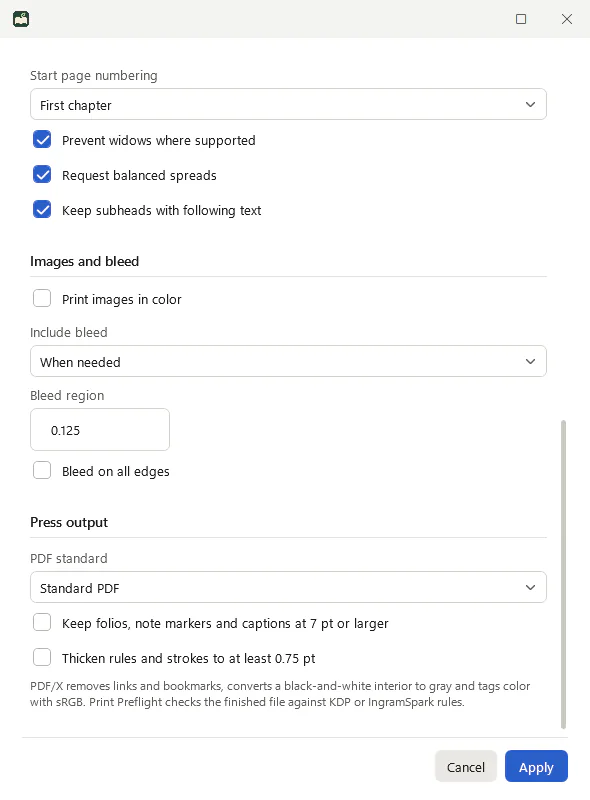
LeafBound’s 128 themes carry the design decisions: typefaces, measure, leading, indents, chapter openings, running heads and folio position, each in Standard, Large print and Accessible versions. The Print and page setup expose the pagination rules as two settings: Prevent widows where supported and Keep subheads with following text. They are settings, not guarantees: the composition engine applies them where a page allows it. The print proof is composed from the same PDF that prints, so what you see on a chapter end is what the reader gets.
Two more settings apply KDP’s floors rather than typographic taste: keep folios, note markers and captions at 7 pt or larger, and thicken rules to at least 0.75 pt. Print preflight then checks the finished PDF for text inside the safe area, including running heads and folios, and for even page numbers on the left.
Typography questions
What is the difference between a widow and an orphan?
A widow is the last line of a paragraph stranded alone at the top of a page or column. An orphan is the first line of a paragraph stranded alone at the bottom. The mnemonic: an orphan is left behind at the start, a widow carries on alone at the end. Usage varies between style guides, so define the terms when you brief a typesetter.
Are widows and orphans really a problem?
Yes, in print. A single line at the top of a page breaks the shape of the text block and reads as a mistake, and a single line at the bottom leaves the paragraph’s sense hanging over the page turn. Typesetters remove them by adjusting word spacing over a few lines, or by adding or removing a line from both pages of the spread. In reflowable ebooks they cannot be controlled, because the reader sets the page.
What is a runt?
A very short last line of a paragraph, often a single word or part of a hyphenated word. It is not a widow unless it also falls at the top of a page. Runts are fixed by tightening or loosening word spacing in the lines above so the paragraph ends with at least two or three words.
What is the running head convention for a novel?
The book title on the verso (left-hand page) and the chapter title on the recto (right-hand page), or the author’s name on the verso and the book title on the recto. Running heads are omitted on display pages: the title page, part openers, chapter openers and blank pages. Nonfiction often puts the chapter title on the verso and the current section heading on the recto.
What is a drop folio?
A page number placed at the bottom of the page instead of in the running head. It is used on chapter openers, where the running head is omitted but the page still needs a number, and in some designs on every page. A blind folio is a page that is counted in the numbering but shows no number at all, such as the title page.
What is a balanced spread?
Two facing pages whose text blocks end on the same baseline. Readers notice when the left page runs a line longer than the right. To keep spreads level, typesetters add or remove a line from both pages of a spread, never from one, which is why widow and orphan fixes are made in pairs.
Does LeafBound fix widows and orphans automatically?
LeafBound’s Print and page setup includes prevent widows and keep subheadings with following text. They are settings that the composition engine applies where it can; they are not guaranteed results, because some pages have no adjustment that satisfies every rule at once. Read the print proof for the pages that matter most, usually chapter ends.
More guides
See the rules on your own pages.
Import your manuscript, choose a theme, switch on widow prevention, and read the print proof that is built from the PDF that will print.
Early access · Author from $79 once · free 4-day trial · Windows 10 and 11